Showing posts with label medieval stereotypes. Show all posts

Thursday, November 5, 2015

You bleed for days each month and don't die? You must be some sort of devil-worshipping witch.

           Simply saying the word ‘menstruation’ often evokes reactions of disgust and feelings of discomfort for many, even some women. We have been cultured to be uncomfortable without realizing it and tend to forget just how long this stigma has surrounded such a normal and natural occurrence in women.
Making a deal with the devil each month.
            A basic state of mind all through history before doctors discovered that periods were linked to ovulation was that women needed to bleed to release their emotional, hysterical, and half-formed natures. Men were seen as being formed in a warm and dry womb while women suffered a cold and wet womb and didn’t develop fully. A nun by the name of Hildegard von Bingen published medical texts saying that period blood cured leprosy, but many also thought that drinking period blood gave one leprosy, so by their beliefs, one had a 50/50 chance of being cured or condemned, which doesn’t seem to be the best healing method. Many also believed the event to have supernatural powers or that could be used to cure sickness or that intercourse during menstruation would result in a monster being born. This specific superstition around women is part of the story of how Merlin is born in HKB when the act of being a woman immediately means that there is something monstrous or demonic about them. Around the middle ages, stories and tales about the superstition surrounding menstruation began accumulate and the ‘insult’ of calling a man a woman or to accuse him of menstruation and being weak became more well-known and accepted as an insult as stories were written down. These instances of insult can be found often throughout the text and since the text is so popular and read by many, being called a woman has remained a demeaning phrase throughout the years and still exists today in many forms.

         
Period blood? Must be witchcraft.
   I suppose to a mind from the distant past, menstruation being a bad thing sounds somewhat logical only due to the fact that losing any amount of blood was seen as dangerous. Women losing blood every month must have really freaked the men out when they had no understanding of the processes of a woman’s body. The need to attribute it to some kind of mysterious cause is understandable, as they had no way to have any more information. Yes, these ideas grew into a hatred for women and all that they are, but the initial and simple concerns were valid. 

Monday, October 5, 2015

Misogyny or Misandry? One Story With Several Readings

So another one of the Canterbury Tales is called The Wife of Bath’s Tale. Chaucer’s story tells that there was a knight in the time of King Arthur who raped a fair maiden, and he was brought before Arthur’s court to be punished. The court decided to put the knight to death, but then Guinevere and the ladies of the court interceded. They decided that if the knight could find out “what thing it is that women most desire” within a year, they would spare his life. So he sets out and I’ll tell you about the ending as I go along. Scholars disagree quite a bit about whether this story is pro-feminist or anti-feminist, but I found a blog where some people think that the answer is obvious. According to the blog, The Wife of Bath’s Tale demonstrates the cruel power women have over men in a gynocentric (woman-focused) society.

Although Chaucer says the knight rapes the maiden, the blog is insistent that you remember that “most men, like most primates” don’t rape people. This is true, but why it needs to be mentioned I couldn’t say. The blog considers it typical that the knight is asked what women desire and rightly points out that “[f]ew today can even imagine asking the question, ‘what do men desire?’” but doesn’t seem to understand why this is. The question of “what women want” has plagued men throughout history because women are considered to be an alien species, mysterious and beyond comprehension. The question of what men want has been answered plenty of times—Gentlemen Prefer Blondes, the 1953 film states, and Cosmopolitan magazine strives to answer it with every issue—but in the end we know that the question is ridiculous because men want a lot of things and every man is different. It’s refreshing that Chaucer acknowledges that every woman wants something different too, because as the knight went around asking women what they most desire, he could not find “two creatures agreeing together.”
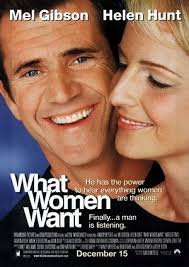
No, I don't want to know what Mel Gibson thinks women want, either.

Until, that is, he met an old woman who promised to give him the answer if he would promise to do whatever she asked. Desperate, he agreed, and she whispered into his ear what to tell the queen. In front of the court the knight declared that “without exception, women desire to have sovereignty as well over her husband as her love, and to be mastery above him.” All the women agreed, and the knight was not executed. The old woman, called the “loathly lady”, then insisted that the knight fulfill his promise by marrying her. He was horrified, but he was forced to give in. “In short, under today’s understanding,” the blog says, “he was raped.” That’s pretty awful. But perhaps we should keep in mind that the knight is in this predicament because he raped a woman by force. Moreover, the blog says, the knight didn’t receive any mercy regarding “the oppressive terms” of his “ill-considered agreement” because he was a man, but he already received mercy from the queen when he was sentenced to death, so maybe he just used up his only “get out of jail free” card.

The loathly lady realized that her new husband didn’t want to touch her because she was so ugly, so she offered him a choice: she could turn herself beautiful, with the result that she would then be plagued by suitors and wouldn’t promise to turn them down, or she could remain ugly and be a “true, humble wife” and never cheat on him and never displease him. Having learned some humility (as I say) or “repressed his desires, nullified his independent thinking, and surrendered his rational agency to his wife” (as the blog says), the knight gave the wife her choice, saying:

My lady and my love, and wife so dear,
I put me in your wise governance;
Choose yourself which may be most pleasure
And most honor to you and me also.

The blog makes it sound as if this applies to every decision ever, instead of just one that has a huge effect on the lady’s body and behavior and that she therefore has a vested interest in. She confirms:

“Then have I gotten mastery of you,” she said,
“Since I may choose and govern as I please?”
“Yes, certainly, wife,” he said, “I consider it best.”

And then she turns beautiful and declares that, since he said the right thing, she will be not only young and beautiful but a perfect, loving, obedient wife, and basically they live happily ever after. So the rapist got a “fairytale” ending instead of his head cut off, and the woman was allowed to have bodily autonomy, and the blogger thinks this is terrible. This must just be a story like the Albina myth, in which two people can happily argue the exact opposite reading with almost the exact same words. Is this a misandrist story because the woman gets control over her husband, or is it a misogynistic story because it portrays women as wanting nothing less than total control of their husbands? Is this story perpetuating negative stereotypes or advocating for some degree of autonomy for women? You decide!

A translation of the tale:

The blog’s take on the tale:
http://gynocentrism.com/2015/09/12/wife-of-bath-criminal-justice-mens-subordination-to-women/

Monday, September 28, 2015

Medieval Jewish Stereotypes in Media From Animation to Music

         About a week ago, I saw a movie with my roommates.  The 2012 animated feature film The Boxtrolls tells the story of an orphan boy who is raised by a community of, well, trolls.  While the story is, at its core, about acceptance of those who are different from the standard norm, the methods of execution of this moral fall short.  The titular box trolls are exemplary of the medieval stereotypes and images of Jews.  They were banished from the human community, only to live in a box-built ghetto, and the general, ignorant public, believes them to kidnap and eat boys.  These strange, bodily, grotesque images were not uncommon in Medieval Europe.  In fact, the Jewish ghetto depicted in the “Prioress’ Tale” adheres to those stereotypes.  So what does it say that this film used Jewish stereotypes to get its point across?
            While Anti-Semitism is still prevalent today, the caricatures of the Medieval past seem to be just that—the antique past.  Perhaps the movie was resurrecting these negative stereotypes because it assumed that people wouldn’t put the pieces together.  However, this decision raises very interesting choices about how caricatures and stereotypes are portrayed in the media.  This stereotype’s age somehow made it more “OK” to be featured in a children’s film.  After all, the purpose of the movie was to bridge the gaps separating different cultures.  The movie actively sought to prove that the real antagonists of the film were the humans who wrongfully accused the trolls of monstrous deeds.  Seemingly, the derogatory stereotypes were redeemed by the fact that these characters were not so different after all.  Does that make it ok though?  Harriet Beecher Stowe’s Uncle Tom’s Cabin was an abolitionist novel, yes, but it is also credited with the creation and/or popularization of some of the most damaging stereotypes.  Stowe utilized negative stereotypes in order to make an anti-slavery argument.  So, yes, The Boxtrolls preaches the acceptance of these anti-Semitic characters, however, it has to blatantly and offensively distinguish them first.
            But perhaps this decision was not entirely intentional.  However, that only reinforces the notion that these anti-Semitic caricatures are ingrained in history. I recall that about a year or so ago, Macklemore performed his hit song “Thrift Shop.”   When he walked on stage, he wore, a wig, and a fake nose, both of which seemed to create an eerily familiar image.  According to an article published in Rolling Stone, he said on his website “I personally thought I looked very ambiguous in terms of any ‘type’ of person’”(Rolling Stone).  Whether or not the singer was telling the truth, this claim raises an interesting point.  Perhaps we, in history, have reached a time where negative stereotypes are so engrained in our minds that we do not even think twice before further preserving them.  To go back to an earlier discussion, one of the characters in The Boxtrolls essentially tells the protagonist that he doesn’t look like a boxtroll.  This could go back to the notion of an individual “looking Jewish.”  These are characters who are distinguished based on appearance, and one perhaps not adhering to those standards could comment on the shock that accompanies an inability to place real life people in categories based on caricatures and stereotypes.
 credit: huffingtonpost


            There could very well exist ignorance regarding medieval Jewish stereotypes.   Perhaps more and more people are recognizing these stereotypes while others remain ignorant.  The point is, they are still being utilized in media to illustrate a moral, they are still being used to be a racial “other,” and both fictional characters and singers alike need to learn of the humanity beneath the surface.