Showing posts with label women. Show all posts

Sunday, April 9, 2017

A Princess in Half Moon Bay


The Princess in The King of Tars is revolutionary, in a Western lens, for staying true to Christianity. Big Little Lies, an HBO series adaptation, is also revolutionary for discussing current day gender issues that are normally overlooked. The two fictional plots are similar in how women are treated as commodities in the eyes of men; however, they differ in the progression of women’s power.

           
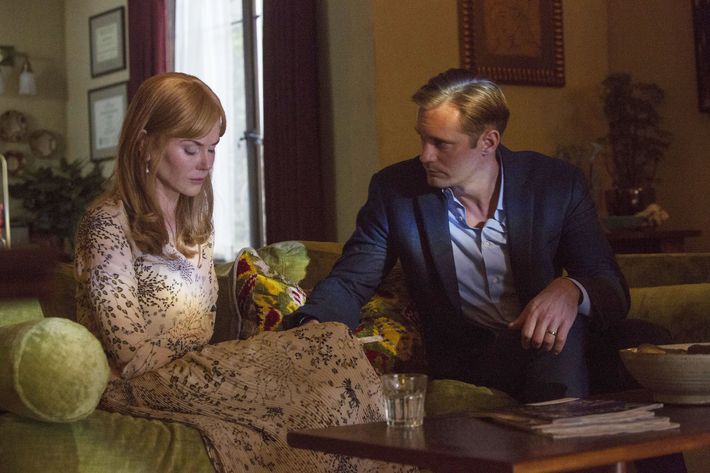
Women have been characterized as a commodity since the medieval period. In The King of Tars, the sultan of Damascus wants to marry the Princess of Tars solely based on her rumored beauty. After the Kingdom of Tars was surrounded by the sultan, the Princess agreed to marry the sultan. Even though the Princess decided to become a peaceweaver, her choice was already decided by the King of Tars because he would have married her off anyways. In a similar situation, the mothers in Big Little Lies gave up their careers for their family. Celeste, played by Nicole Kidman, was a successful lawyer who gave up her career, home, and family ties to be with Perry, played by Alexander Skarsgard. Perry degrades Celeste through verbal and physical assault. Everyone in Half Moon Bay, where the series takes place, views Celeste and Perry as the perfect couple. Celeste no longer feels independent because Perry wants to mold her into his ideal wife. The Princess and Celeste are not seen as humans but rather as meaningful property.


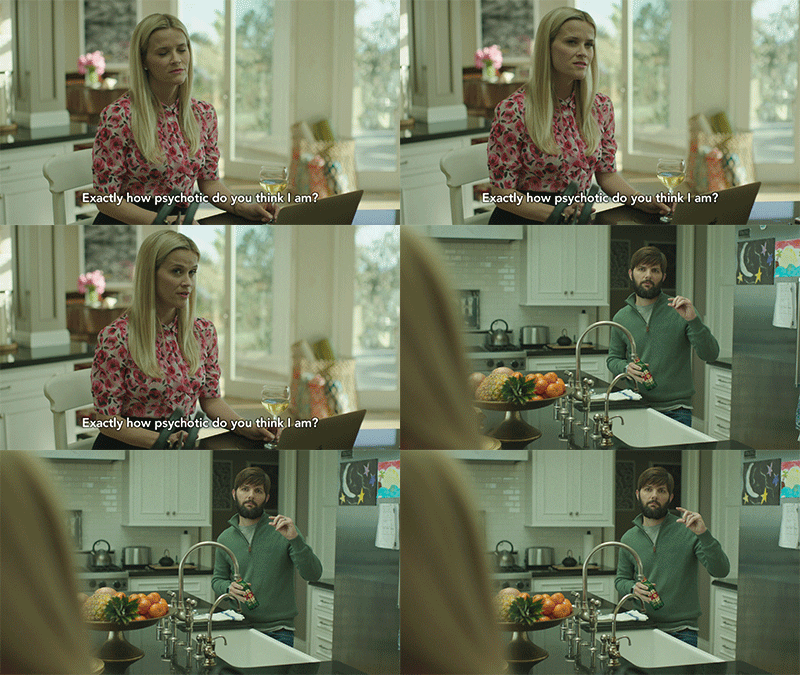
            Since the medieval period, women’s power has progressed tremendously. The Princess of Tars secretly kept her Christian faith, instead of truly committing to the sultan by converting. The Princess challenges the sultan to change their lump baby into a regular child and whoever won deemed their religion superior. It resulted in the sultan having to convert to Christianity since the Princess won. Even though the Princess had to stay with the sultan, she went beyond her defined role of domesticity to challenge her husband. In medieval context, her actions were radical but she set the stage for women’s emerging dominance. In Big Little Lies, Madeline, played by Reece Witherspoon, exemplified the power women can have. Madeline went to great lengths to protect their local community production from Renata, played by Lauren Dern, and the mayor shutting it down for being controversial. Madeline also fought against Renata in the principal’s office because Renata wants to suspend a child who was wrongfully accused of being a bully towards her daughter. Madeline shows how even as a housewife, women’s power cannot be limited by social constraints. From the start of the season, Madeline has evoked mothers to channel to the power that they thought they have lost. The evolution of women’s power can be seen from the Princess of Tars challenging the sultan to Madeline vocalizing her opinion to powerhouses in Half Moon Bay.  

            Women have been tagged as commodities from as far back as the medieval age to the present. The sultan views the Princess of Tars only for her beauty and used her as a peaceweaver. Perry views Celeste as a perfect housewife that can be molded into his ideal image. However, The King of Tars allowed for present women to identify their true strength, which is showcased in Big Little Lies.

Sunday, February 26, 2017

Harvest Moon: Gender Bender or Just Homophobic

            Harvest Moon, now called Story of Seasons, is a simulator role-play game that came out in Japan in 1996. Since then it has developed 30+ spin-off games with various story lines taking place in various eras. A large component of these games are marriage candidates; NPC's that a programmed for the sole purpose of raising their friendship and romance “levels” with the intent of eventually marrying them to have them help out with some of your daily routines in-game.
            A current source of scrutiny as new games develop is the inability to date characters of the same gender; attempting to date a candidate of the same gender only increases friendship and not romance. Many players have expressed their dislike at this mechanic and when questioned a few years ago year the company Marvelous (formerly Natsume) and creator Yasuhiro Wada said they understood is was a mechanic that had to be incorporated eventually but it would be more complicated than that; requiring “homosexual-specific” characters and that it would increase the overall game data capacity.
            However, with the 2016 release of the indie game Stardew Valley- whose creator Eric Barone (alias ConcernedApe) was heavily inspired by the Japanese sim- allowed every marriage candidate available to the player, regardless of gender. It is unsure if Harvest Moon will follow suit but in-between the interview and the release of Stardew Valley they came out with Harvest Moon: A New Beginning that unlocks all the customization options regardless of gender. So, for example, if you wished to marry a male character as a male you still had to choose female but there was the option of making your girl look like a male however they would still use female pronouns and your character would still wear a dress when married.

            Many think this is a cop-out since it’s not actually same sex but, for the conservative Japanese society, should this be considered progressive or would that be lenient towards them solely due to their social standing? While many medieval texts were actually quite progressive they were edited to hide “trans-gendered” males, women posing as men saving other women, and just women being with other women. Many see the medieval era as absent of any form of LGBT representation due to the later eras’ erasure and because of this it is many people’s basis to not include this representation in their video games. Is the Japanese company Marvelous being progressive with their “gender bender” options or is there still some underlying opposition towards the LGBT community?

Monday, October 5, 2015

Misogyny or Misandry? One Story With Several Readings

So another one of the Canterbury Tales is called The Wife of Bath’s Tale. Chaucer’s story tells that there was a knight in the time of King Arthur who raped a fair maiden, and he was brought before Arthur’s court to be punished. The court decided to put the knight to death, but then Guinevere and the ladies of the court interceded. They decided that if the knight could find out “what thing it is that women most desire” within a year, they would spare his life. So he sets out and I’ll tell you about the ending as I go along. Scholars disagree quite a bit about whether this story is pro-feminist or anti-feminist, but I found a blog where some people think that the answer is obvious. According to the blog, The Wife of Bath’s Tale demonstrates the cruel power women have over men in a gynocentric (woman-focused) society.

Although Chaucer says the knight rapes the maiden, the blog is insistent that you remember that “most men, like most primates” don’t rape people. This is true, but why it needs to be mentioned I couldn’t say. The blog considers it typical that the knight is asked what women desire and rightly points out that “[f]ew today can even imagine asking the question, ‘what do men desire?’” but doesn’t seem to understand why this is. The question of “what women want” has plagued men throughout history because women are considered to be an alien species, mysterious and beyond comprehension. The question of what men want has been answered plenty of times—Gentlemen Prefer Blondes, the 1953 film states, and Cosmopolitan magazine strives to answer it with every issue—but in the end we know that the question is ridiculous because men want a lot of things and every man is different. It’s refreshing that Chaucer acknowledges that every woman wants something different too, because as the knight went around asking women what they most desire, he could not find “two creatures agreeing together.”
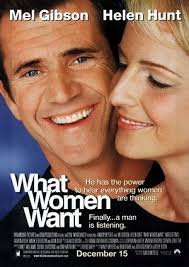
No, I don't want to know what Mel Gibson thinks women want, either.

Until, that is, he met an old woman who promised to give him the answer if he would promise to do whatever she asked. Desperate, he agreed, and she whispered into his ear what to tell the queen. In front of the court the knight declared that “without exception, women desire to have sovereignty as well over her husband as her love, and to be mastery above him.” All the women agreed, and the knight was not executed. The old woman, called the “loathly lady”, then insisted that the knight fulfill his promise by marrying her. He was horrified, but he was forced to give in. “In short, under today’s understanding,” the blog says, “he was raped.” That’s pretty awful. But perhaps we should keep in mind that the knight is in this predicament because he raped a woman by force. Moreover, the blog says, the knight didn’t receive any mercy regarding “the oppressive terms” of his “ill-considered agreement” because he was a man, but he already received mercy from the queen when he was sentenced to death, so maybe he just used up his only “get out of jail free” card.

The loathly lady realized that her new husband didn’t want to touch her because she was so ugly, so she offered him a choice: she could turn herself beautiful, with the result that she would then be plagued by suitors and wouldn’t promise to turn them down, or she could remain ugly and be a “true, humble wife” and never cheat on him and never displease him. Having learned some humility (as I say) or “repressed his desires, nullified his independent thinking, and surrendered his rational agency to his wife” (as the blog says), the knight gave the wife her choice, saying:

My lady and my love, and wife so dear,
I put me in your wise governance;
Choose yourself which may be most pleasure
And most honor to you and me also.

The blog makes it sound as if this applies to every decision ever, instead of just one that has a huge effect on the lady’s body and behavior and that she therefore has a vested interest in. She confirms:

“Then have I gotten mastery of you,” she said,
“Since I may choose and govern as I please?”
“Yes, certainly, wife,” he said, “I consider it best.”

And then she turns beautiful and declares that, since he said the right thing, she will be not only young and beautiful but a perfect, loving, obedient wife, and basically they live happily ever after. So the rapist got a “fairytale” ending instead of his head cut off, and the woman was allowed to have bodily autonomy, and the blogger thinks this is terrible. This must just be a story like the Albina myth, in which two people can happily argue the exact opposite reading with almost the exact same words. Is this a misandrist story because the woman gets control over her husband, or is it a misogynistic story because it portrays women as wanting nothing less than total control of their husbands? Is this story perpetuating negative stereotypes or advocating for some degree of autonomy for women? You decide!

A translation of the tale:

The blog’s take on the tale:
http://gynocentrism.com/2015/09/12/wife-of-bath-criminal-justice-mens-subordination-to-women/